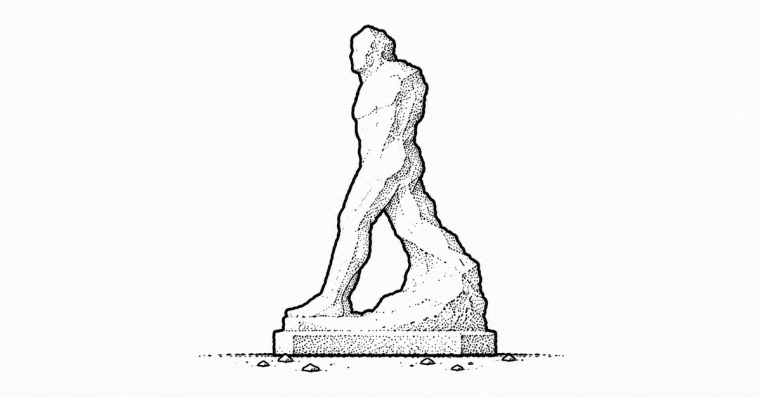
One of my favorite artists is Rodin. His sculptures have always fascinated me, both for their beauty and their peculiarities. His controversial style, by the way, led him to repeatedly fail when trying to enter the Grand École, the School of Fine Arts. The judges, educated by neoclassical taste, did not accept his sculpting techniques. One of these techniques was known as non finito, literally meaning not finished.
The technique comes from Platonic philosophy that any work of art will never equal the object it inspires. Although it is not a Renaissance tradition, this thought did not prevent many sculptors of that time from marking their works with faciebat, which would signal that it is unfinished, in progress. This word is found next to Michelangelo's signature on the famous Pietà.Indeed.
The Renaissance obsession with perfection and verisimilitude, that is, making your work look like something real, on one hand greatly advanced classical composition techniques. On the other hand, if a work will never equate to its object, when will it truly be complete? I also tend to fall into this trap in the projects I undertake. Trim one more edge. Fix one more bug. Refine a transition, an effect, a field. In the end, perfection is just another disguise for not delivering.The same goes for our life, in general. The obsession for perfection turns into an obsession in a desire to reach infinity. We are not immune to this. Neither was Michelangelo.
This brings me back to Rodin. More precisely, to my favorite sculpture of his, 'The Walking Man.' It is one of his most famous 'unfinished' works, depicting the body of a man in motion. Because we too are unfinished works, in progress. And just like the sculpture, we are not incomplete, but always in motion.
So publish your project, complete your task, finish your post (okay, that was more for myself). And if you find yourself thinking of a thousand details that prevent your completion, write at the end: faciebat.